What a charger on your land actually earns
How a site gets priced, what the DISCOM connection costs, and the numbers we can and cannot tell you up front.
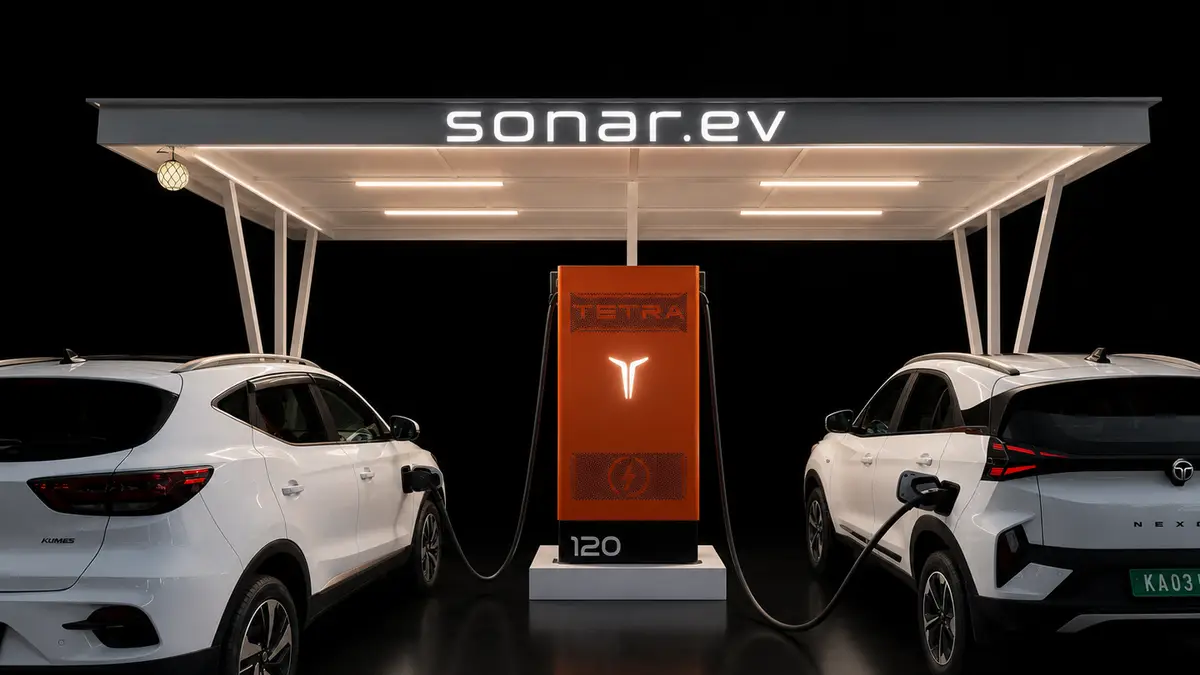
This is the question every landowner asks first, and it is the one question we will not answer on a landing page. Not because the number is embarrassing, but because anybody who quotes you a monthly figure before seeing your site is quoting you somebody else's site.
What we can do is be precise about what the figure depends on, so you can form a view before you ever talk to us.
The four things that decide it
Traffic, and what kind. A charger earns when a car is plugged into it. What matters is not how many vehicles pass, but how many pass with a reason to stop for twenty minutes — a highway junction with food nearby beats a faster road with nothing on it. This is why the survey looks at approach and dwell, not just vehicle count.
Sanctioned load and transformer capacity. This is usually the constraint nobody expects. A site can be perfect on traffic and still be unable to take a 120 kW unit because the local transformer has nothing spare. Upgrading it is possible and it is not free, and the cost lands in the project either way. We check transformer capacity and sanctioned load during the survey precisely because finding out afterwards is the expensive version.
The hardware the site justifies. We deploy from 24 kW up to 320 kW. A destination bay at a hotel and a highway ultra-fast hub are different machines with different capital costs and completely different utilisation curves. Fitting a 320 kW unit to a site that will never fill it is the most common way these projects lose money.
The tariff you buy power at. Commercial EV charging tariffs vary by state and by DISCOM, and they move. The spread between what you pay for a unit and what a driver pays for it is the business, and it is not the same spread in every state.
What the land actually has to do
Less than people assume. Under the revenue-sharing and member participation models, a site can be built without the landowner carrying the capital cost — hardware, civil works, electrical infrastructure and commissioning are run as one contract with one owner. What you are contributing is the location, the approach and the grid position.
That is also why we would rather tell you early that a site does not work. A survey that ends in "no" costs us a fortnight; a station built on a site that cannot fill it costs considerably more than that, and it costs it for years.
The shape of the timeline
From the published process, and roughly:
- Day 0 — you submit the location. Five minutes, no fee.
- 1–2 weeks — site and grid survey. Transformer capacity, sanctioned load, approach, traffic.
- 2–3 weeks — commercial terms, revenue share and the agreement, in writing.
- 4–8 weeks — civil works, electrical infrastructure, installation, safety testing.
- Days — network integration. The station joins the map, billing goes live, telemetry starts reporting.
Call it three to four months from application to a station that is earning, assuming the survey comes back clean and the DISCOM does not queue you. Both of those are real assumptions and either can move it.
The part nobody budgets for
A charger nobody maintains stops earning within about a month. Not gradually — it fails, and then it sits there failing while drivers who tried it once stop trying. This is why operations and maintenance is a line in the contract with an uptime commitment attached rather than something to sort out later. An unmaintained charger is not a lower-yielding asset; it is a dead one with a bill attached.
So: what does it earn?
After the survey, we will tell you, in writing, with the assumptions written next to it. Before the survey, anyone who tells you is guessing.
Submit a location — it costs nothing and it is the only way to find out.
ScalePath prepares founders and makes introductions. It does not guarantee investment, and no one on the platform will promise you one.